Space Peppers, Five Years On: What NASA’s 137-Day Chile Grow-Out Tells Us About Seed Prep and Fruit Safety
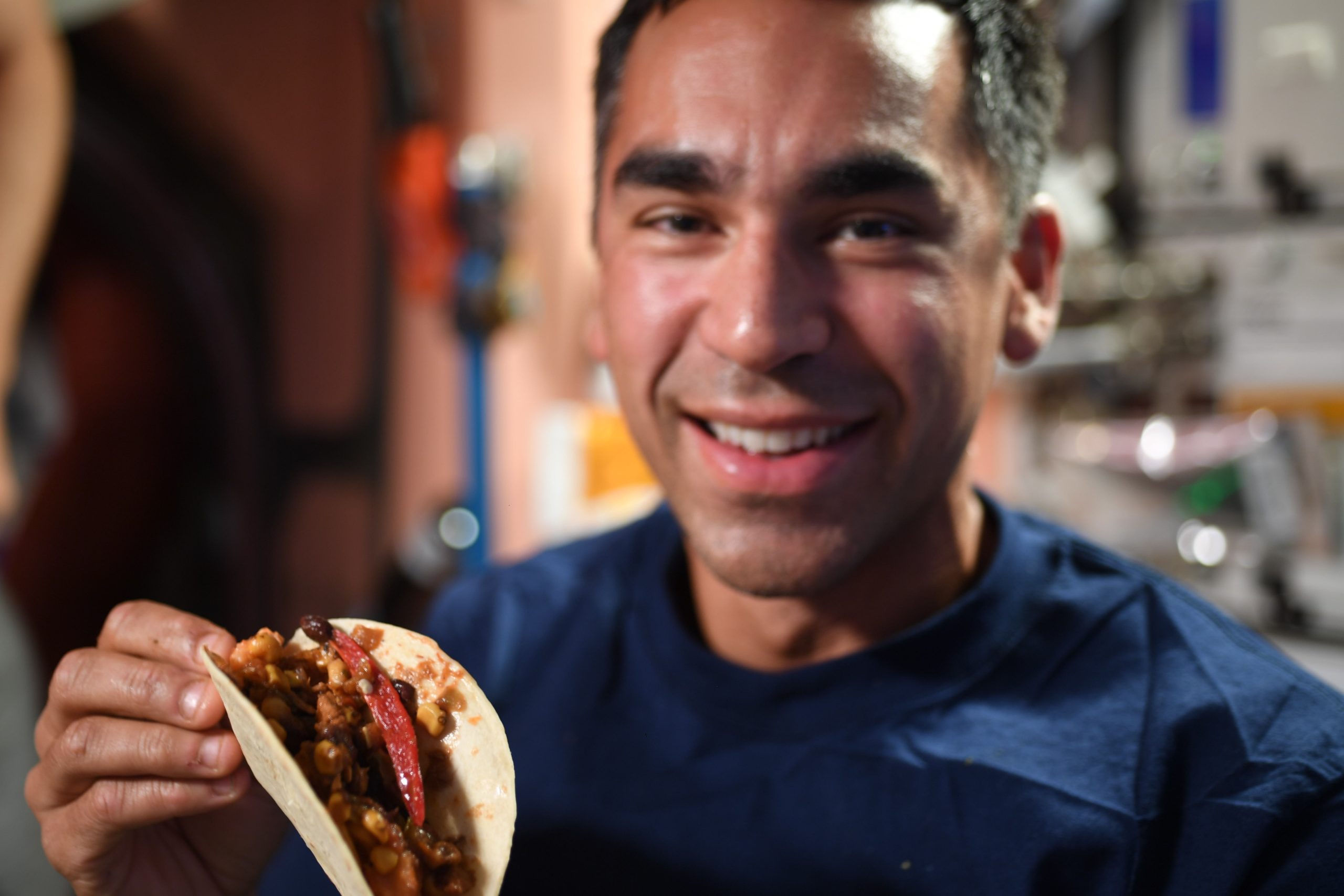
The story most people know is the taco. In late 2021, astronauts aboard the International Space Station ate chile peppers they had grown themselves, and the internet did what the internet does. What got less attention is that the peppers came home frozen, went into a lab at Kennedy Space Center, and stayed there for four years. The results were finally published this January — and buried in them is a finding that has nothing to do with space and everything to do with how any of us handle seed.
The grow-out
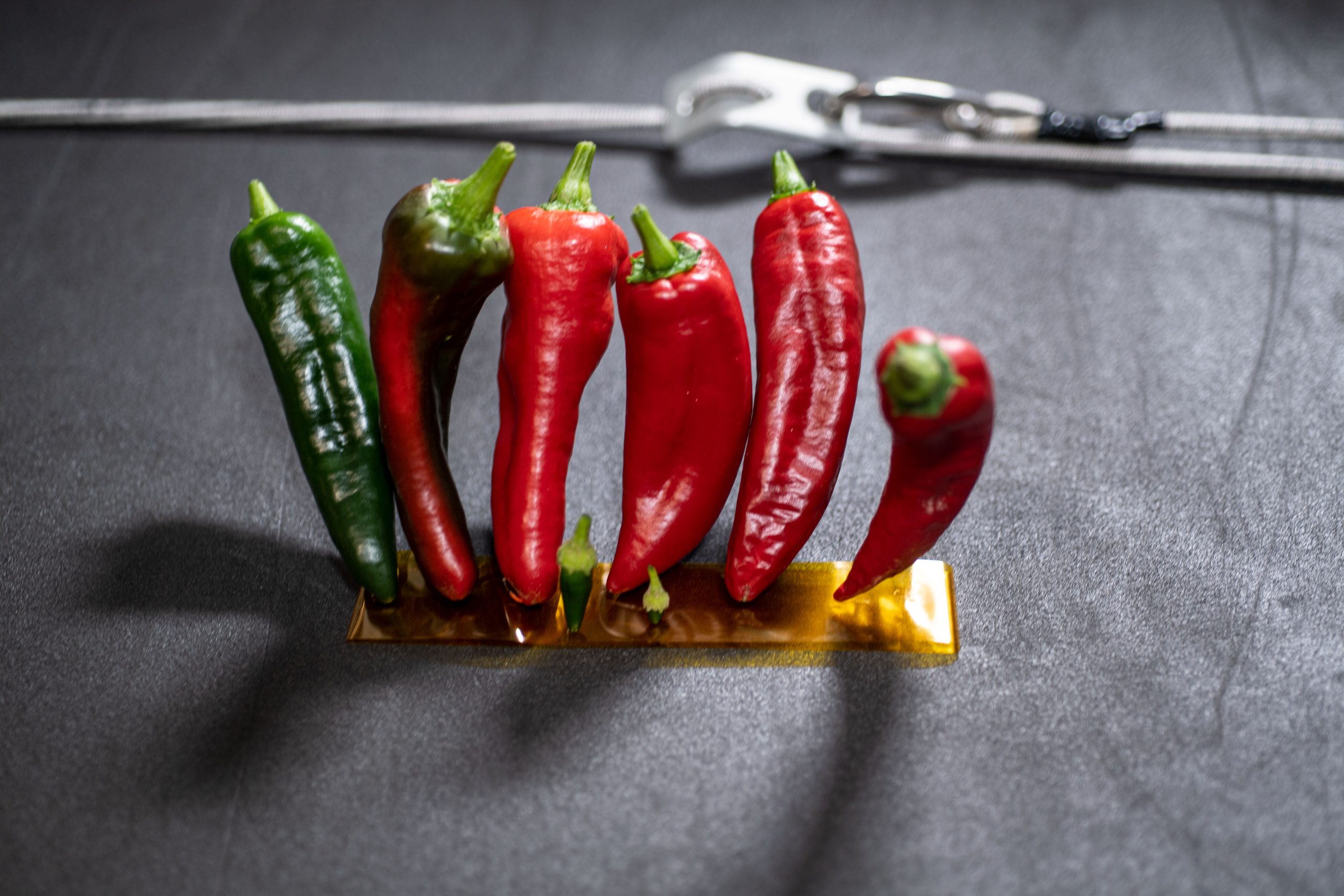
NASA’s Plant Habitat-04 (PH-04) was a technology demonstration, not a science experiment in the strict sense — a proof of concept to see whether a fruiting crop could be carried all the way to harvest in orbit. Forty-eight surface-sanitized seeds were planted at Kennedy in April 2021, launched on SpaceX CRS-22 that June, and installed in the Advanced Plant Habitat on July 12 by astronaut Shane Kimbrough. Twelve seeds went into each of the habitat’s four independent quadrants; the crew thinned them down to one plant per quadrant on day 28.
The habitat is a closed, automated chamber with more than 180 sensors, tele-operated from Florida. Growers will recognize most of the levers: a 16-hour photoperiod, roughly 300 µmol/m²/s, CO₂ held at 550 ppm, humidity dropped from 80% to 50% after germination, and a controlled-release fertilizer prilled into a sterilized ceramic substrate. Two things stand out. The light spectrum was pushed to 40% blue specifically to keep internodes short and the plants under 40 cm — a dwarfing trick done with photons instead of genetics. And because there is no gravity-driven air movement, the team ran the chamber fans up to 0.9 m/s for five minutes a day once flowering began to move pollen, with crew members hand-pollinating every flower on top of that.
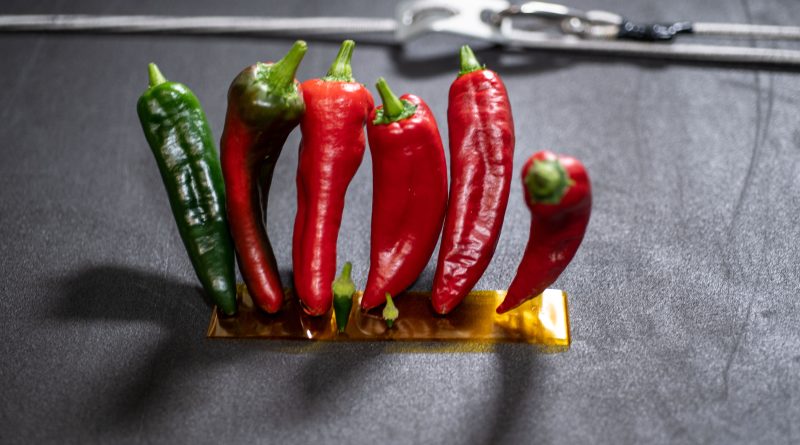
The run was planned for 120 days. Fruiting lagged about two weeks behind ground trials, most likely a germination delay tied to how water behaves in microgravity, so the harvests slid to days 109 and 137. Twenty-six edible peppers came off four plants — the longest edible-crop grow-out in station history and, for what it’s worth, the record for most astronauts fed from a single space-grown crop.
The straight pedicels
The morphological oddity everyone latched onto is real, and it is more specific than the headlines suggest. It was not the main stems that came out straight — it was the pedicels, the short stems joining flower and fruit to the plant. On Earth those curve. In orbit they did not. Principal investigator Matt Romeyn called it plainly a microgravity effect. If you have ever wondered how much of a pod’s presentation is genetics and how much is the plant negotiating with gravity, there is your answer for at least one part of the architecture.
Crew feedback also suggested some of the fruit ran hotter than expected. That is anecdotal — no capsaicin assay was published — but it is a reasonable thing to expect from a plant under stress, and it is the kind of observation that ought to make anyone formulating to a target Scoville pay attention to growing conditions as much as cultivar.
What was actually living on the fruit
Half the crop was eaten. The other half went into the station’s −80 °C freezer, came home in January 2022, and was worked up at Kennedy. The results published in Scientific Reports in January 2026 are, on the food-safety side, about as clean as a result gets. Bacterial and fungal plate counts on the fruit ran from below the detection limit up to 111 CFU per gram fresh weight — and that single high number came off one pepper in one quadrant. No Salmonella, no E. coli, no coliforms, no Staph aureus. Nothing the team screened for turned up.
For context, 111 CFU/g is a number most of us would be delighted to see on incoming raw product. Sequencing the V4 region of the 16S rRNA gene told a more textured story: the fruit and leaves carried low-diversity communities dominated by Sphingomonas, Novosphingobium and Pseudomonas, while the root zone and substrate carried roughly twice as many species. Only fourteen genera were shared across every sample type — a possible core microbiome, but one accounting for just 4.5% of total reads. Over 95% of what was found was specific to a tissue or a component.
The seed-sanitizing question
Here is the part worth arguing about at your next food safety meeting.
The seeds were surface-sanitized before flight by chlorine gas fuming — bleach and hydrochloric acid in a sealed container for an hour, then an overnight off-gas. Standard practice, and it worked: sanitized seed showed markedly less Sphingomonas than unsanitized seed from the same lot.
But Sphingomonas has been identified elsewhere as a seed endophyte that confers disease resistance. The authors raise the possibility, carefully and without overclaiming it, that the sanitization step may be stripping the plant of part of its own defense system right at the start. They also note the genus rebounded during the grow-out and turned up in the progeny seed, which points to vertical transmission from parent to offspring — so the plant apparently gets it back one way or another, whether from the surviving population or from cabin air.
That tension is not a space problem. Anyone running a seed-treatment protocol — hot water, bleach dip, fungicide, anything — is making the same trade without necessarily having the data to price it. The sterile seed is the safe seed on day one. It may not be the resilient plant on day sixty. Nobody has resolved this, and the PH-04 paper does not claim to. It just puts a marker down.
A note on the name
Coverage of PH-04 almost universally calls this a Hatch chile. It is worth being precise, because our industry gets sloppy about appellations and then complains when consumers do.
The cultivar is NuMex Española Improved, released in 1984 by Roy Nakayama and Frank Matta at New Mexico State University. It was chosen from more than two dozen candidates after phenotyping under simulated ISS conditions, taste panels, and nutrient testing — it is a medium-heat pepper, 2,000–4,000 SHU, and it happens to suit controlled environments well. It is a New Mexican pod type frequently grown in the Hatch Valley, which is where the shorthand comes from. But peppers grown in a sealed box 250 miles above the Earth are, by any reasonable reading of the term, not Hatch chiles.
The parentage is also worth flagging, because the sources disagree. The Scientific Reports paper describes the cross as Hatch Big Jim × traditional Española. NMSU’s own materials, seed catalogs carrying the variety, and 2021 coverage from New Mexico outlets all give it as Sandia × the Española landrace. Both cite the same 1984 Matta and Nakayama release note. Sandia appears to be the correct parent; we have queried NMSU’s Chile Pepper Institute and will update this piece if they tell us otherwise.
Why a trade audience should care
Two reasons, neither of them about Mars.
The first is that closed-environment pepper production is coming to a warehouse near you whether or not anybody leaves orbit. Vertical farming has largely stuck to leafy greens because fruiting crops are hard — they need pollination, fruit set, and a long ripening window. PH-04 is one of the more thoroughly instrumented demonstrations anywhere that a Capsicum can be carried to harvest in a fully sealed chamber, and the environmental setpoints are published. If you have been told indoor peppers do not pencil out, the horticultural half of that objection is weaker than it was.
The second is the microbiome work itself. Project manager Nicole Dufour’s team was not sampling fruit for the sake of it — they were building a baseline for what a plant-associated microbial community looks like in a system where you control every input. That is an unusually clean dataset, and the questions it opens about seed sanitation, endophyte loss and plant defense apply to a field in Mississippi as much as to a growth chamber in the Kibo module.
NASA’s next fruiting-crop targets are dwarf tomatoes, with microgreens, legumes and herbs in the pipeline. Peppers got there first.
Sources
- Khodadad, C.L.M., Dixit, A.R., Hummerick, M.E., et al. “Evaluating microbial community profiles of Chile peppers grown on the International Space Station provides implications for fruiting crops.” Scientific Reports 16, 12863 (23 January 2026). doi:10.1038/s41598-025-20440-9 (open access). Underlying data: NASA GeneLab OSD-772.
- Costa, J. “NASA’s Second Pepper Harvest Sets Record on Space Station.” NASA Kennedy Space Center, 30 November 2021. nasa.gov
- Herridge, L. “Chile Peppers Start Spicing Up the Space Station.” NASA Kennedy Space Center, July 2021. nasa.gov
- Matta, F.B. & Nakayama, R.M. “Española Improved Chile Pepper.” HortScience 19(3), 454 (1984).
- Coon, D. & Bosland, P.W. “The Chile Cultivars of New Mexico State University Released from 1913 to 2016.” NMSU Research Report 792. pubs.nmsu.edu
- Photographs: NASA (public domain).